 Ethiopia Is Investing in Yesterday's Healthcare
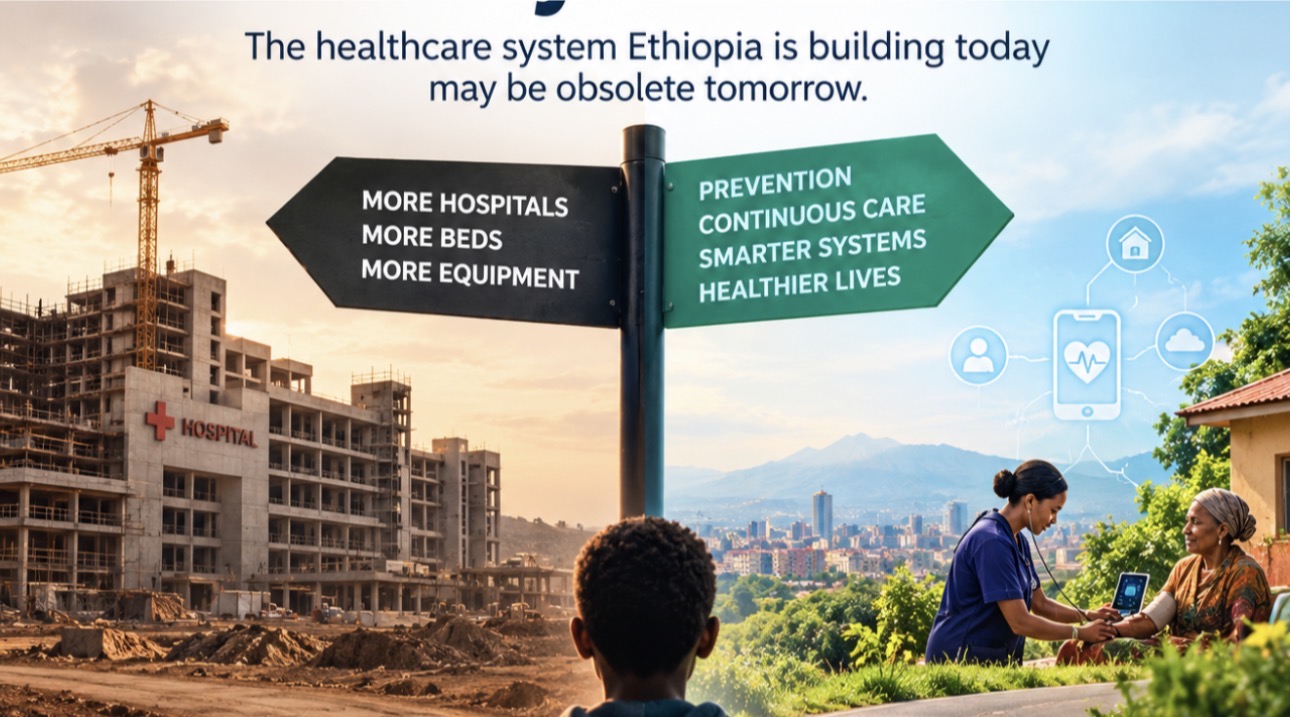
The healthcare system Ethiopia is building today may be obsolete tomorrow.
Having a strong healthcare system is an important indicator of a country's development. Ethiopia has invested significantly in healthcare over the past several decades and has made meaningful progress in health service delivery. Yet the country still lags significantly in achieving universal health coverage, and much more needs to be done to make healthcare accessible, affordable and equitable.
With this in mind, there are currently several major healthcare investments underway across Ethiopia, by both public and private-sector stakeholders. These investments are commendable and, without question, much needed.
However, there is an important pattern in healthcare investment in Ethiopia, and across much of Africa, that deserves serious attention.
To understand it, we need to briefly look at how our health systems evolved over the past five decades.
We built the health system around the problems we had
For decades, Ethiopia and much of Africa faced an enormous burden of infectious diseases. Malaria, tuberculosis, HIV/AIDS, pneumonia, diarrheal diseases and other infections dominated the health landscape.
Understandably, this shaped how our healthcare systems were designed.
The investments made to tackle these challenges were essential. They saved lives and produced meaningful progress, even if much more remains to be done.
But, in the background, another transition was taking place.
The prevalence of non-communicable diseases and, perhaps more importantly, the risk factors driving them was steadily increasing. Diabetes. Hypertension. Chronic kidney disease. Cancer. Cardiovascular disease. Mental health conditions.
These were discussed, but often without the scale of strategic investment that their future burden demanded.
We are now facing the consequences of that gap. NCDs account for roughly 38% of deaths in Ethiopia, while prevention, screening, early detection, treatment and rehabilitation remain significantly underdeveloped.
I will explore this discrepancy in more depth in a future blog.
What if our biggest healthcare risk is not underinvestment?
My work at Innova Healthcare Consultancy and Lifeline Addis Home-based Health Care has given me a somewhat unusual perspective: I have had the opportunity to see healthcare both from the policy and strategic level and from the last-mile delivery level.
And this has led me to a somewhat uncomfortable conclusion:
Ethiopia's greatest healthcare risk may not be underinvestment. It may be investing heavily in the wrong architecture.
This raises some important questions.
• What healthcare trends are we missing today that could cost us tomorrow?
• How do we bridge the investment we urgently need today with the healthcare system we will need tomorrow?
• Are the systems we are building today future-proof or, more importantly, future-resilient?
I believe there are at least four trends we need to think much more seriously about.
1. Healthcare is moving from centralized care to decentralized and personalized care
With the emergence of remote patient monitoring, continuous monitoring, connected devices, the Internet of Things and artificial intelligence, healthcare is increasingly moving closer to the patient.
As these technologies mature and scale, they have the potential to make many forms of care more accessible, personalized and eventually less expensive.
The implications are profound.
Hospitals will remain essential. But increasingly, hospitals are becoming one part of a much larger care ecosystem supported by day procedures, minimally invasive interventions, remote monitoring, hospital-at-home models, home-based care, rehabilitation and community-based services.
Yet in Ethiopia, there sometimes appears to be a hidden race toward building the next hospital with the largest number of beds.
It is not uncommon to hear:
“We are building a 500-bed hospital.”
There is nothing inherently wrong with a 500-bed hospital. In a country with Ethiopia's population and healthcare deficits, we need more capacity.
But the number of beds is increasingly the wrong headline metric.
While the world is asking how to make healthcare more distributed, predictive, personalized, continuous and data-driven, we are still often asking how many beds a hospital will have.
A hospital should be evaluated not only by how many beds it has, but by the efficiency and outcomes of the system around those beds.
• How effectively does it prevent unnecessary admissions?
• How does it reduce length of stay and readmissions?
• How does it collect and use patient data to prevent illness and complications?
• How effectively does it connect with primary care and community-based services?
• How is it financed to achieve the difficult balance between affordability and quality that Ethiopia's health system has long struggled with?
The conversation should be less about the number of beds and the specifications of the latest MRI, and more about the intelligence, efficiency, outcomes and resilience of the system those assets are embedded within.
2. Artificial Intelligence is not a futuristic add-on. It is part of the infrastructure of future healthcare.
AI is already changing how healthcare can be delivered from diagnosis and clinical decision support to triage, monitoring, documentation and population health.
This is not simply another technology trend or another software platform.
We should think of AI as part of the infrastructure upon which tomorrow's healthcare system will operate.
And this may be one of the biggest risks to today's healthcare investments.
If the hospitals, information systems, medical devices and workflows we build today cannot accommodate increasingly intelligent, interoperable and data-driven tools, some of today's investments may become difficult and expensive to adapt.
Before chasing the next PET scanner or competing to be the first facility in Ethiopia to acquire the latest technology, perhaps we should ask:
• How will this technology change with AI?
• Is the infrastructure we are building AI-ready?
• Will the data generated today be usable by the tools of tomorrow?
If done correctly, the AI revolution could actually give Ethiopia and Africa an unprecedented opportunity.
AI may make some of Africa's constraints less constraining.
A continent with too few specialists, too few healthcare professionals and vast geographic disparities in access could potentially use AI to extend the reach and productivity of scarce expertise.
But only if we build the underlying infrastructure correctly.
3. Aging is the healthcare industry Ethiopia isn't preparing for
Yes, Africa is the youngest continent in the world.
But being young today does not mean we will remain young forever.
WHO projects that the population aged 60 and above in Africa could reach approximately 165 million by 2050.
This is partly a consequence of something we should celebrate: people are living longer.
But longevity will bring its own healthcare challenges.
• More chronic disease.
• More multimorbidity.
• More dementia.
• More disability.
• More rehabilitation.
• More long-term care.
• More demand for home-based and community-based care.
Ethiopia currently has very limited geriatric medicine infrastructure and specialized training. We are not yet adequately prepared for the scale and complexity of the care needs that an aging population will create.
And this raises another question:
Are we building a healthcare system for the demographics we have or for the demographics we are going to have?
A country that does not care well for its elderly cannot build a truly hopeful society.
We need to begin thinking about the care economy as a core component of the future healthcare system and not an afterthought.
4. Tertiary care cannot come at the expense of primary care
I increasingly hear sophisticated terminology around new healthcare projects:
Comprehensive referral medical campuses. Medical cities. Quaternary care. Centers of excellence.
We obviously need many of these and more.
But they should not come at the expense of primary healthcare.
Primary healthcare has become politically and commercially less glamorous precisely at the moment it is becoming more important.
The healthcare system of the future will not be defined only by the spectacular buildings we can inaugurate.
Much of it will exist in places that are far less visible: in the data, in the community, in the home, in the care network, in the early detection system, in the insurance architecture, and in the invisible coordination between all of them.
The question is therefore not whether Ethiopia needs tertiary hospitals.
It obviously does.
The question is:
What is the right balance between primary, secondary and tertiary care if we design the system with the next 20–30 years in mind?
And how should our investments reflect that balance?
The irony
Perhaps the greatest irony is this:
The healthcare system of the future may require less physical capital than the healthcare system we are trying to build today—but much more intelligence, coordination and governance.
That does not mean we should stop building hospitals.
It means we should stop thinking that building hospitals is synonymous with building a healthcare system.
A hospital bed tells us how much physical capacity we have built.
It does not tell us how much health we have created.
The future health system will increasingly be judged by different questions:
• How many complications did we prevent?
• How early did we detect disease?
• How many people can we keep healthy and independent?
• How effectively can we manage chronic disease over decades?
• How much unnecessary hospitalization can we prevent?
• How accessible is care outside the hospital?
• How intelligently are we using data and technology?
• How much health do we create for every dollar invested?
These may ultimately become more meaningful measures of healthcare development than the number of beds we build.
Ethiopia has an enormous healthcare investment gap. We must fill it. But as we do, we should ask one more question:
Are we building the healthcare system Ethiopia needs today—or the healthcare system Ethiopia will need tomorrow?
Because we have learned this lesson once already. The disease burden changes. Healthcare changes. Technology changes.
And our health system needs to change with them.
What important questions are we not asking today as we build the healthcare system of tomorrow?